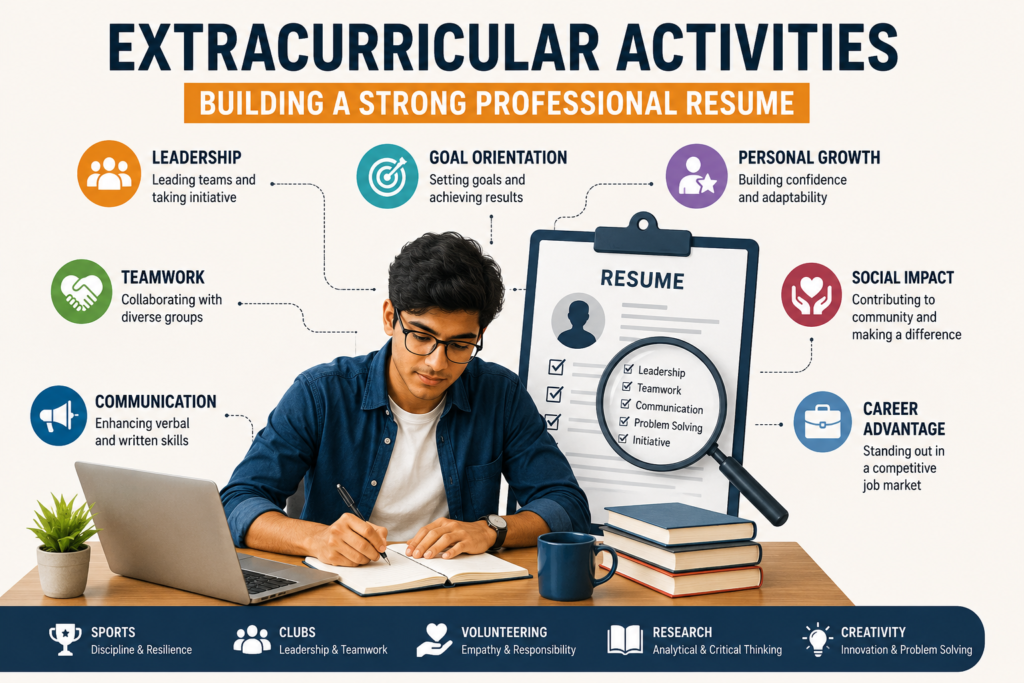
In an increasingly competitive job market, a degree alone is often not enough to distinguish a candidate from the crowd. Recruiters are no longer just looking at GPA and major; they are scanning for the “X-factor”—the proof of character, leadership, and real-world application of skills. This is where extracurricular activities become a cornerstone of a high-impact professional resume.
Whether you are a college student or a recent graduate, your involvement in clubs, sports, volunteer organizations, or research projects is not just a hobby. It is an opportunity to showcase your potential as a professional.
1. Why Employers Value Extracurriculars
When a hiring manager reviews a resume, they are looking for evidence of soft skills. While your academic transcripts demonstrate knowledge, your extracurricular activities demonstrate your ability to use that knowledge in dynamic environments.
Participation in activities provides tangible evidence of:
- Soft Skill Development: Communication, conflict resolution, and empathy.
- Initiative: Showing that you are a self-starter who contributes outside of mandatory requirements.
- Cultural Fit: Demonstrating your ability to work within a team toward a shared goal.
2. Transforming Hobbies into Professional Assets
The mistake many candidates make is listing extracurriculars as a simple bulleted list of titles (e.g., “President of Chess Club”). To turn these into professional assets, you must quantify your impact.
Use the “Action + Context + Result” Framework
Instead of just saying what you did, explain the value you added.
- Weak: “Member of the marketing club.”
- Strong: “Coordinated a campus-wide marketing campaign for a local charity, resulting in a 30% increase in donations over three months.”
By framing your activities through the lens of accomplishments, you show employers that you understand how to drive results.
3. High-Value Extracurriculars and the Skills They Build
A. Leadership Roles (Student Government, Club Boards)
These roles are gold for entry-level resumes. They prove you have experience in:
- Strategic Planning: Setting goals and managing budgets.
- Team Management: Motivating others to achieve a collective outcome.
- Conflict Resolution: Navigating disagreements between members.
B. Volunteer and Community Service
Employers value community engagement because it signals strong emotional intelligence (EQ) and social responsibility. It suggests that you are grounded, empathetic, and capable of working with diverse groups of people.
C. Sports and Team Athletics
Athletics tell a unique story about a candidate. They imply:
- Resilience: The ability to bounce back from failure.
- Discipline: Dedication to training and consistent practice.
- Coachability: The ability to receive feedback and adjust performance accordingly.
D. Academic Research and Professional Societies
These are highly relevant if you are entering technical or research-heavy fields. They prove that you have the discipline for deep work and the ability to collaborate with subject matter experts.
4. How to Position Extracurriculars on Your Resume
Placement and formatting depend on your level of experience.
- For Students/New Grads: Since you lack long-term work experience, your “Extracurricular Activities” section can be placed prominently. It may even be grouped under a broader “Leadership and Experience” heading.
- For Experienced Professionals: If you have 3+ years of work experience, move extracurriculars to the bottom under “Community Involvement” or “Volunteer Work.” Focus only on those that align with your current career trajectory.
5. Avoiding Common Pitfalls
While extracurriculars are beneficial, they can backfire if handled incorrectly:
- Over-listing: Including every single club you briefly joined in your freshman year looks like “resume filler.” Curate only the most impactful experiences.
- Lack of Relevance: If you are applying for a software engineering role, your role as the captain of the intramural frisbee team is fun, but perhaps not as relevant as your participation in a coding hackathon.
- Vague Descriptions: Never assume the employer knows what a specific organization does. Provide a brief, one-sentence description if the organization isn’t widely known.
6. The “AI-Proof” Strategy
As recruitment processes increasingly use Applicant Tracking Systems (ATS) and AI screening, your resume must be keyword-optimized. When describing your extracurriculars, use professional verbs and industry-standard terminology:
- Instead of “helped with,” use “Spearheaded,” “Collaborated,” “Engineered,” or “Negotiated.”
- If your role involved managing money, use words like “Budget allocation,” “Revenue growth,” or “Cost-saving measures.”
Frequently Asked Questions (FAQ)
Are hobbies considered extracurriculars?
Generally, no. A hobby (e.g., gaming, watching movies) is personal. An extracurricular involves community, structure, leadership, or skill-building. Only include hobbies if they directly relate to the job or demonstrate a unique, high-level skill.
Should I include activities from high school?
Once you are in your second or third year of college, start phasing out high school activities unless they are exceptionally prestigious or demonstrate a lifelong commitment to a cause.
What if I haven’t done any extracurriculars?
It’s never too late. Even late in your academic career, joining one club, organizing a singular event, or volunteering for a local organization can add a layer of depth to your resume that is missing today.
Conclusion
Extracurricular activities are the bridge between your academic life and your professional future. They tell a story about who you are, how you work, and what you value. By intentionally choosing activities that challenge you, and by strategically showcasing your achievements, you turn your resume into more than just a list of credentials—you turn it into a compelling narrative of leadership and capability.
Start today: Audit your involvement, draft your accomplishments using the action-context-result framework, and watch how these experiences elevate your professional profile in the eyes of hiring managers.
Ready to build a standout resume? Contact our career coaching team for a personalized review of your professional profile.