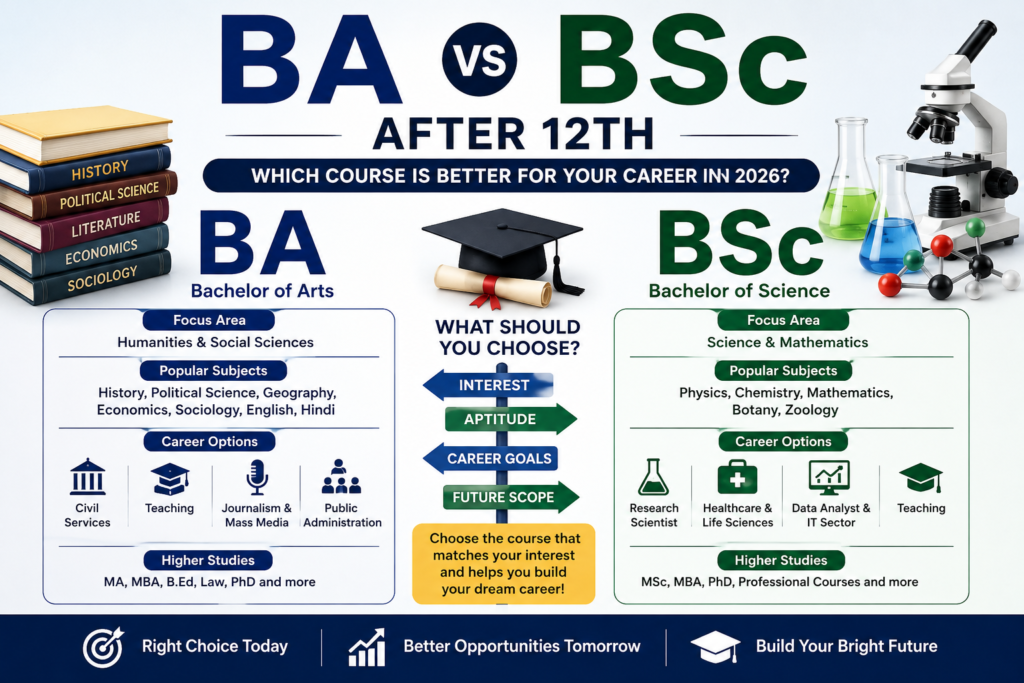
If you are confused about BA vs BSc after 12th, comparing the courses before taking admission can help you make a better decision. Choosing the right graduation course after Class 12 is an important decision that can shape your academic journey and future career. Among the most popular undergraduate options, BA (Bachelor of Arts) and BSc (Bachelor of Science) are two courses that attract students with different interests and career goals.
But the question remains: BA vs BSc after 12th—which course is better for your career in 2026?
The answer depends on your academic background, interests, strengths and long-term goals. If you enjoy subjects such as History, Political Science, Geography, Economics, Sociology or Literature, BA after 12th may be a suitable choice. If you enjoy Physics, Chemistry, Mathematics or Biology and prefer scientific and analytical learning, BSc after 12th may be a better fit.
In this detailed guide, we compare BA vs BSc in 2026, including subjects, eligibility, career options, higher studies, government job opportunities and how to choose the right course and college in Jaipur.
BA vs BSc After 12th: Quick Comparison
Before choosing between BA and BSc, it helps to understand the basic difference between the two courses.
| Feature | BA | BSc |
| Full Form | Bachelor of Arts | Bachelor of Science |
| Main Area | Humanities & Social Sciences | Science & Mathematics |
| Ideal For | Students interested in arts, society, languages and humanities | Students interested in science, mathematics and analytical subjects |
| Popular Subjects | History, Political Science, Geography, Economics, Sociology, Literature | Physics, Chemistry, Mathematics, Botany, Zoology |
| Career Areas | Education, administration, media, civil services, research | Science, research, education, laboratories, analytics |
| Higher Studies | MA, MBA, B.Ed, Law, PhD and other programmes | MSc, MBA, research programmes and specialised courses |
| Competitive Exams | UPSC, RPSC, SSC, Banking and others | UPSC, RPSC, SSC, Banking and others |
In simple terms: BA generally focuses on people, society, culture, language and humanities, while BSc focuses more on scientific concepts, mathematics and analytical learning.Understanding the differences between BA vs BSc after 12th can help students choose a degree that matches their academic strengths.
BA vs BSc After 12th: Which Course Is Better?
BA, or Bachelor of Arts, is a three-year undergraduate degree that allows students to study subjects related to humanities, social sciences, languages and other disciplines.
Students searching for BA courses after 12th often choose this programme because it provides flexibility in subject selection and can support a wide range of career and higher-education pathways.
Depending on the college and programme structure, BA students may study subjects such as:
- History
- Political Science
- Geography
- Economics
- Sociology
- English Literature
- Hindi Literature
For students interested in BA admission in Jaipur, choosing the right subject combination is particularly important because it can influence future higher studies and areas of specialisation.
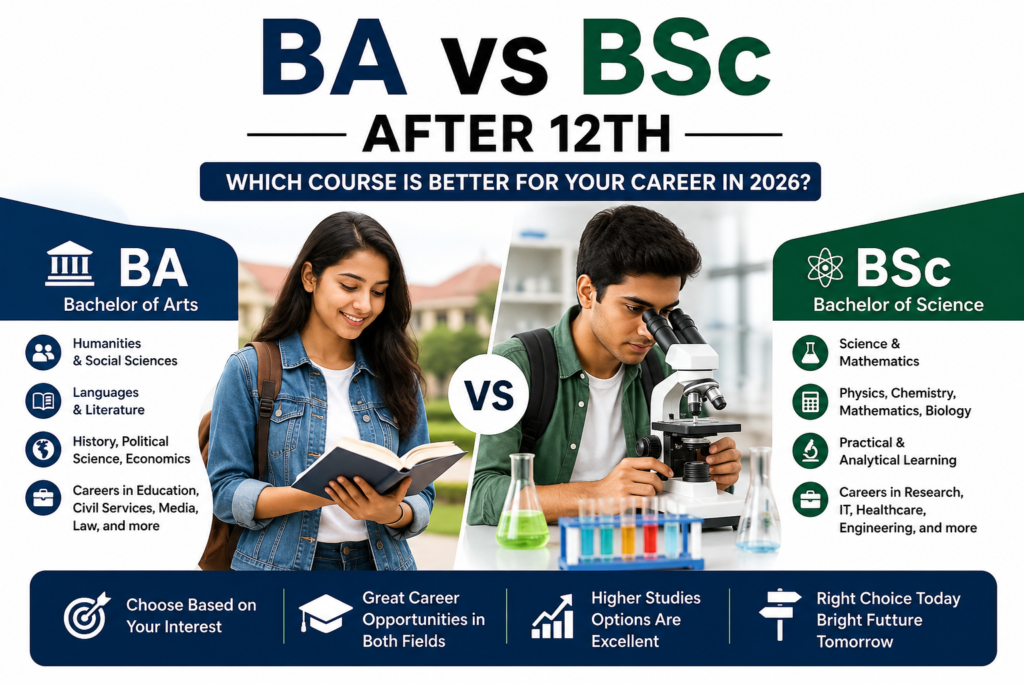
What Is BSc After 12th?
BSc, or Bachelor of Science, is an undergraduate degree designed for students who want to continue studying scientific and mathematical disciplines after Class 12.
Students searching for BSc courses after 12th can explore different subject combinations depending on their Class 12 background and the programmes offered by a college.
Common BSc subjects can include:
- Physics
- Chemistry
- Mathematics
- Botany
- Zoology
At Agrasen College, Kukas, Jaipur, the BSc programme includes science combinations such as PCM and CBZ. Students should check the latest college admission guidelines for current eligibility and subject requirements.
For students searching for BSc colleges in Jaipur, it is important to compare subjects offered, laboratories, faculty, university affiliation, academic facilities and overall learning environment before making a decision.
BA vs BSc: Which Course Is Better?
There is no universal answer to BA or BSc which is better.
The better course is the one that matches your:
- Academic interests
- Strengths
- Class 12 subjects
- Career goals
- Higher-study plans
- Preferred learning style
BA may be better for you if:
- You enjoy reading and writing.
- You are interested in history, politics or society.
- You enjoy languages and literature.
- You are interested in humanities and social sciences.
- You are considering civil services or public administration.
- You want to explore careers in education, media or administration.
BSc may be better for you if:
- You enjoy science and mathematics.
- You like analytical problem-solving.
- You are interested in scientific concepts.
- You enjoy practical or laboratory-based learning.
- You want to pursue MSc or research.
- You are interested in science-related career pathways.
Therefore, don’t choose a course simply because someone says it is “easier” or “has more scope.” Choose the programme that fits your interests and long-term plans.
BA vs BSc After 12th: Which Is Easier?
One of the most common questions students ask is:
“BA vs BSc which is easier?”
The answer varies from student to student.
A student who enjoys reading, writing, social sciences and humanities may find BA more comfortable. Another student who enjoys mathematics, science and practical learning may find BSc more engaging.
Difficulty should therefore not be the primary factor in your decision.
Instead, ask yourself:
What subjects do I genuinely enjoy studying?
When students choose a course according to their interests and strengths, they are more likely to remain motivated throughout their graduation.
BA vs BSc: Difference in Subjects
The biggest difference between BA and BSc is their academic focus.
BA Subjects
Depending on the college, BA students may study:
- History
- Geography
- Political Science
- Economics
- Sociology
- English
- Hindi
These subjects can help develop communication, analytical, research, writing and critical-thinking skills.
BSc Subjects
Depending on the programme, BSc students may study:
- Physics
- Chemistry
- Mathematics
- Botany
- Zoology
These subjects generally involve scientific concepts, quantitative reasoning, analytical thinking and, where applicable, practical or laboratory learning.
BA vs BSc After 12th: Career Scope in 2026
Both BA and BSc can provide a foundation for different career paths.
However, your degree alone does not determine your career. Skills, experience, postgraduate education, internships, certifications and competitive-exam preparation can all influence your professional opportunities.The career scope of BA vs BSc after 12th depends on the student’s subject choice, skills and future qualifications.
Career Options After BA
After completing a BA degree, students can explore areas such as:
- Civil services
- Government examinations
- Teaching
- Journalism
- Media
- Content writing
- Digital marketing
- Human resources
- Public administration
- Research
- Social services
- Higher education
Students can also pursue postgraduate and professional qualifications such as MA, MBA, B.Ed, Law and other specialised programmes.
For students researching career options after BA, the best pathway will depend on their chosen subjects and career interests.
Career Options After BSc
BSc graduates can explore career and higher-study opportunities in areas related to their specialisation.
Possible pathways include:
- Scientific research
- Laboratory work
- Teaching
- Research assistance
- Science-related industries
- Environmental fields
- Analytics-related roles
- Government examinations
- Higher education
- Specialised professional programmes
Students can also pursue MSc after BSc, MBA, research programmes and other qualifications.
The career scope of BSc can vary significantly according to the subject combination and additional qualifications a student completes.
BA or BSc for Government Jobs: Which Is Better?
Students preparing for government examinations often ask whether BA or BSc is better for government jobs.
In many competitive examinations, graduates from different academic disciplines can apply, provided they meet the specific eligibility criteria of the examination.
Therefore, there is no rule that BA automatically provides better government job opportunities than BSc—or vice versa.
If you are planning to prepare for UPSC, RPSC, SSC, Banking or other competitive exams, choose the degree that:
- Matches your interests.
- Helps you maintain strong academic performance.
- Gives you sufficient time for exam preparation.
- Develops useful communication and analytical skills.
- Supports your long-term education plans.
For students interested in civil services, subjects such as History, Geography and Political Science can be relevant to areas commonly studied for competitive examinations. However, students from science backgrounds can also prepare successfully for these examinations.
BA for UPSC and RPSC Preparation
Many students consider BA for UPSC or RPSC preparation because subjects such as History, Geography, Political Science and Economics overlap with areas commonly studied in civil-services preparation.
However, students should remember that a BA degree does not guarantee success in UPSC or RPSC examinations.
Success depends on factors such as:
- Consistent preparation
- Understanding the examination pattern
- Current-affairs awareness
- Answer-writing skills
- Revision
- Mock tests
- Time management
Students from BSc and other graduation backgrounds can also prepare for civil-services examinations if they meet the relevant eligibility requirements.
BA vs BSc: Higher Education Opportunities
Your graduation degree can become the foundation for further education. Another important factor in BA vs BSc after 12th is the higher-education pathway available after graduation.
Higher Studies After BA
A BA graduate may consider:
BA → MA → PhD / Research / Teaching
BA → MBA → Management
BA → B.Ed → Teaching
BA → Law → Legal Career
BA → Competitive Exams → Government Services
There are also opportunities in media, communications, public administration and other specialised fields.
Higher Studies After BSc
A BSc graduate may consider:
BSc → MSc → Research / Teaching
BSc → MBA → Management
BSc → Research Programme → Scientific Career
BSc → Competitive Exams → Government Services
The right pathway depends on your BSc specialisation and career objectives.
BA vs BSc Salary: Which Has Higher Earning Potential?
Searching for BA vs BSc salary can be useful, but students should be careful about comparing degrees based only on starting salary.
Income depends on many factors, including:
- Job role
- Industry
- Skills
- Experience
- Location
- Specialisation
- Higher qualifications
- Employer
- Professional certifications
For example, a BA graduate who develops strong digital marketing, communication or management skills may follow a very different career path from another BA graduate.
Similarly, a BSc graduate with specialised technical knowledge or postgraduate qualifications may have different opportunities from another BSc graduate.
Therefore, degree + skills + experience + specialisation is a more useful way to think about career growth than degree name alone.
Skills Students Should Build During Graduation in 2026
Regardless of whether you choose BA or BSc, developing additional skills can improve your career readiness.
Students can consider developing:
1. Communication Skills
Strong written and verbal communication can be useful across almost every career.
2. Digital Skills
Basic computer knowledge, online research and productivity tools are increasingly important.
3. Data and Analytical Skills
Students can develop basic data interpretation and analytical abilities relevant to their field.
4. Research Skills
Research and information-evaluation skills are valuable for higher education and many professional roles.
5. Presentation Skills
Being able to communicate ideas clearly can benefit students in academics, interviews and professional environments.
6. English Language Skills
Strong English communication can broaden opportunities across education and employment.
7. Problem-Solving
Analytical thinking and practical problem-solving are useful regardless of your degree.
How to Choose the Best Graduation Course After 12th
If you are confused about the best graduation course after 12th, follow these steps.
Step 1: Identify Your Interests
Ask yourself which subjects you genuinely enjoy.
Do you prefer History and Political Science?
Or do you prefer Mathematics and Physics?
Your answer can help you narrow down your options.
Step 2: Consider Your Class 12 Stream
Your Class 12 subjects may influence which undergraduate programmes you are eligible to pursue.
Always check the latest eligibility criteria of the college and programme.
Step 3: Think About Your Career Goal
Do you want to prepare for government examinations?
Do you want to become a teacher?
Are you interested in research?
Do you want to work in media, administration, science or another field?
Your long-term goal should influence your choice.
Step 4: Research the College
Don’t choose a college only because of its name.
Check:
- University affiliation
- Course availability
- Eligibility
- Fees
- Faculty
- Laboratories
- Library
- Campus facilities
- Student support
- Location
- Admission process
Step 5: Compare Your Options
Make a simple list of the advantages and limitations of each course.
This can make your final decision much easier.
Why Choose Agrasen College, Kukas, Jaipur?
Students searching for a BA college in Jaipur or BSc college in Jaipur should consider colleges that offer suitable academic programmes, recognised affiliation and a supportive learning environment.
Agrasen College, located in Kukas, Jaipur, offers undergraduate BA and BSc programmes along with postgraduate options. The college has been affiliated with the University of Rajasthan since 2018.
The college provides facilities designed to support students’ academic and extracurricular development, including a library, laboratories, sports facilities, auditorium, ICT facilities and other campus resources.
For students comparing best colleges in Jaipur, it is important to evaluate the course, eligibility, facilities, affiliation and overall academic environment rather than relying on a single ranking or advertisement.
BA Admission in Jaipur: What Should Students Check?
If you are planning BA admission 2026, make sure you understand:
- Eligibility requirements
- Available subjects
- Admission dates
- Required documents
- Fee structure
- University affiliation
- Course duration
- College facilities
Students should always verify the latest admission information directly with the college before applying.
BSc Admission in Jaipur: What Should Students Check?
Students planning BSc admission 2026 should check:
- Required Class 12 subjects
- Eligibility criteria
- Available combinations
- Admission schedule
- Required documents
- Fees
- Laboratory facilities
- University affiliation
- Higher-study opportunities
Choosing the right BSc subject combination can be particularly important because it may influence future postgraduate and career options.
BA vs BSc After 12th: Which One Should You Finally Choose?
The decision becomes easier when you match the degree with your interests.
Choose BA if you are interested in:
Humanities + Social Sciences + Languages + Society + Government Exams + Education + Media
Choose BSc if you are interested in:
Science + Mathematics + Analytical Learning + Practical Work + Research + Scientific Studies
Neither BA nor BSc is automatically the “better” degree.
The best course is the one that helps you build a strong academic foundation and move toward your desired career.
If you are still confused, speak with your parents, teachers or academic counsellors and compare the latest course and admission information before making your final decision.
Final Verdict: BA vs BSc After 12th in 2026
So, BA vs BSc after 12th—which course is better for your career in 2026?
The answer depends on your interests, strengths and career goals. Ultimately, BA vs BSc after 12th is not about choosing the universally “better” degree, but about choosing the course that fits your goals.
Choose BA if you are passionate about humanities, social sciences, languages, society, public administration, education, media or civil-services preparation.
Choose BSc if you enjoy science, mathematics, analytical thinking, practical learning and scientific subjects, and are interested in higher studies or careers related to science and research.
Most importantly, remember that your graduation degree is only one part of your career journey. Building relevant skills, gaining practical experience, pursuing higher education and consistently improving yourself can make a significant difference.
If you are looking for BA or BSc admission in Jaipur, Agrasen College, Kukas, can be one of the colleges you consider while comparing your options.
Explore the available courses, understand the eligibility requirements and choose the programme that best matches your future goals.
Frequently Asked Questions About BA vs BSc
1. Is BA or BSc better after 12th?
Neither is universally better. BA is generally suited to students interested in humanities and social sciences, while BSc is suited to students interested in science and mathematics.
2. Which is better, BA or BSc for government jobs?
Many government examinations accept graduates from different disciplines. Students should check the eligibility requirements of the specific examination they plan to take.
3. Which course is easier, BA or BSc?
It depends on the student’s interests and academic strengths. Students who enjoy humanities may find BA more comfortable, while students who enjoy science and mathematics may prefer BSc.
4. What are the best BA subjects?
Common BA subjects include History, Political Science, Geography, Economics, Sociology, English Literature and Hindi Literature.
5. What are the best BSc subjects?
Depending on the college and eligibility, BSc subjects can include Physics, Chemistry, Mathematics, Botany and Zoology.
6. Can I prepare for UPSC after BA?
Yes. Graduates can prepare for UPSC subject to the examination’s eligibility requirements. BA subjects such as History, Geography and Political Science may also align with areas commonly studied for civil-services preparation.