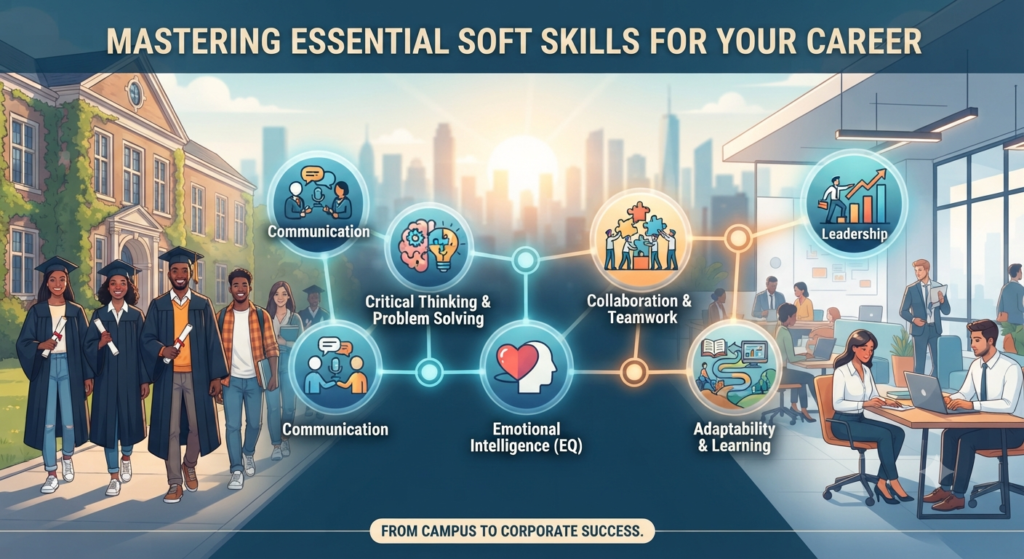
The modern job market is undergoing a seismic shift. While technical knowledge (hard skills) like coding, accounting, or engineering can get your resume past the initial screening, it is your soft skills—the human elements of your professional profile—that will get you hired and help you climb the corporate ladder.
As you prepare to transition from the lecture hall to the boardroom, your technical grades will eventually matter less than your ability to communicate, adapt, and lead. Here is your roadmap to the essential soft skills for students that will define your career success.
1. Communication: Beyond Just Speaking
Communication is the bedrock of professional life. It is not just about having a strong vocabulary; it is about clarity, active listening, and the ability to convey complex ideas simply.
- Verbal Communication: The ability to articulate your thoughts during meetings or presentations.
- Written Communication: Essential in the age of remote work. Crafting clear, concise emails, reports, and digital messages is non-negotiable.
- Active Listening: This is the most underrated communication skill. When you listen to understand rather than to respond, you build trust and gain valuable insights.
2. Critical Thinking and Problem Solving
Employers are looking for graduates who don’t just follow instructions but think through challenges. Critical thinking involves analyzing information objectively, identifying biases, and making logical decisions.
- The Analytical Approach: When faced with a problem, don’t jump to the first solution. Gather data, weigh the pros and cons, and consider the long-term impact of your decisions.
- Adaptability: The world changes fast. Critical thinkers are better at pivoting when the initial plan fails.
3. Emotional Intelligence (EQ)
Emotional Intelligence is the ability to recognize, understand, and manage your own emotions, while also influencing the emotions of others. High EQ is often the biggest differentiator between a good employee and a great leader.
- Self-Awareness: Knowing your triggers and your strengths.
- Empathy: Understanding the perspectives of your teammates or clients. This is essential for conflict resolution and fostering a positive team culture.
4. Time Management and Self-Discipline
In college, professors provide a syllabus and deadlines. In the professional world, you are often the project manager of your own time.
- Prioritization: Mastering tools like the Eisenhower Matrix (separating the urgent from the important) is a game-changer.
- The Deep Work Habit: Learn to focus on high-impact tasks for long periods without the distraction of notifications. This ability is becoming increasingly rare and, therefore, highly valuable.
5. Collaboration and Teamwork
“I am a team player” is a standard resume cliché, but can you prove it? Collaboration is about contributing to a group effort while respecting the diverse strengths of your colleagues.
- Conflict Resolution: Disagreements are inevitable. The ability to navigate these with professionalism rather than hostility is a core soft skill.
- Interdisciplinary Work: Being able to work with people from different backgrounds (e.g., a technical developer working with a marketing strategist) is vital for innovation.
6. Adaptability and Continuous Learning (Growth Mindset)
The skills you learn in college may be obsolete in five years. The ability to learn, unlearn, and relearn is the ultimate soft skill.
- Growth Mindset: As coined by psychologist Carol Dweck, a growth mindset is the belief that your abilities can be developed through dedication.
- Curiosity: Always ask “why?” Stay updated with industry trends, emerging technologies, and new methodologies.
7. Leadership Skills
You don’t need a managerial title to be a leader. Leadership, at its core, is about influence, initiative, and responsibility.
- Taking Initiative: Spotting a problem and fixing it without being asked.
- Mentorship: Being willing to share your knowledge and help others grow, regardless of your seniority.
How to Develop These Skills While Still in College
You don’t need a job to practice these skills. You can start today:
- Join Student Organizations: This is the perfect training ground for teamwork and leadership.
- Take on Group Projects: Instead of delegating, volunteer to coordinate the group—this builds leadership and communication skills.
- Seek Feedback: Ask professors or mentors for constructive criticism on your work. This builds the humility and resilience necessary for high EQ.
- Volunteer: Working in diverse community settings is one of the fastest ways to build empathy and adaptability.
Frequently Asked Questions (FAQ)
Are soft skills more important than hard skills?
They are complementary. Hard skills get you the interview; soft skills get you the job. As you advance in your career, soft skills typically become more important than your technical expertise.
How do I highlight soft skills on my resume?
Don’t just list them (e.g., “Good communicator”). Incorporate them into your experience bullet points. For example: “Led a team of five students to organize a campus event, improving inter-departmental communication.”
Can you learn soft skills?
Absolutely. Unlike many hard skills that require specific software or training, soft skills are behavioral. They are improved through intentional practice, reflection, and feedback.
Conclusion
Mastering these essential soft skills for students is not an overnight task. It is a lifelong practice of self-improvement. By intentionally focusing on your communication, emotional intelligence, and ability to think critically, you are doing more than just earning a degree—you are building a sustainable, high-value career.
The transition to the workforce is challenging, but those who arrive equipped with both technical competence and human-centric skills will not just survive—they will thrive.
Ready to level up your professional profile? Start by picking one skill from this list and applying it to your next project today.